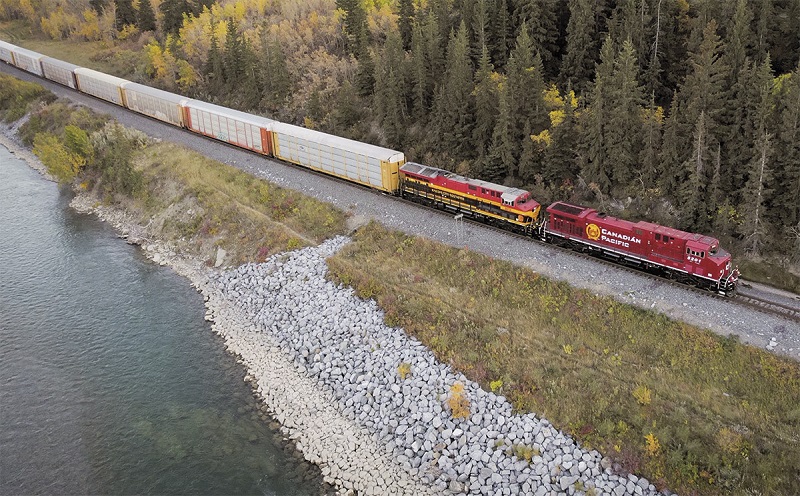
Canadian Pacific Kansas City invests USD 120 Million in Two Laredos
By Editorial
July 4, 2023
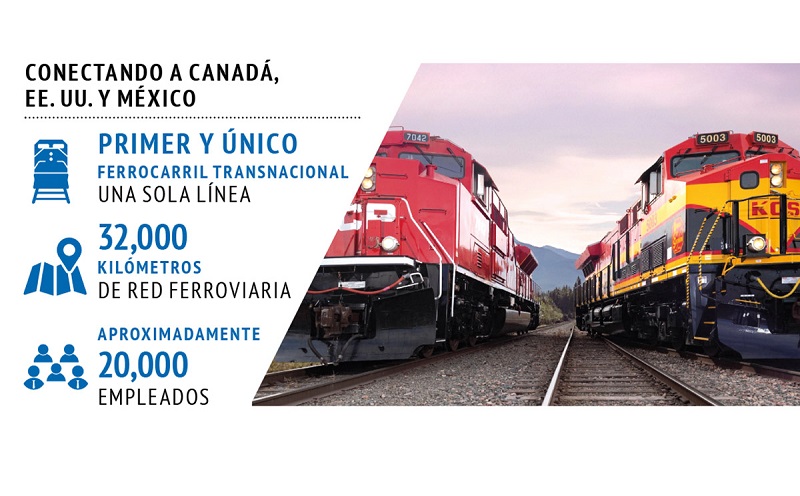
After the announcement of the purchase of Kansas City Southern by the Canadian Pacific Railway in 2021, for 31 billion dollars, finally in March 2023 the SBT ( United States Land Transportation Board) confirmed the authorization for the formation of the firm CPKC (Canadian Pacific Kansas City), which represents a historic moment for logistics in the region, as it becomes the first rail operator of a single line among the three countries that make up the T-MEC (Mexico, the United States and Canada ).
This operation represents a significant commitment for the railway company, which expects to achieve growth of one billion dollars in the next three years and double-digit sales growth; but it is also a sign of strengthening logistics and rail infrastructure for Mexico.
Óscar del Cueto, president of CPKC in Mexico , explained to México Industry that this responds to the identification of the arrival of new companies and investments in the country, mainly from the automotive sector. “There is a base of companies that want to reach the United States from Mexico with greater agility. We have the same schedule, we share 3,000 km of border and an outstanding connectivity of ports, highways and railways”.
He explained that with the incorporation of Canada, new routes are opened for the company, since “before we only reached the center of the United States. Today, we already cover the eastern and middle United States, as well as all of eastern Canada.”
This translates into an uninterrupted connection from the port of Lázaro Cárdenas to Montreal (including Vancouver in western Canada) with significant benefits in terms of time and agility in the movement of goods. With the formation of the new company, 32,000 km of railway network are added and connecting a large number of ports, including 4 Mexican ones: Lázaro Cárdenas, Altamira, Tampico and Veracruz.
The route of the tracks in Mexican territory extends over 15 states and covers the most important industrial zones, linking 65 transfer terminals and three intermodal stations: Salinas Victoria, San Luis Potosí and Puerta México. In addition, it connects with two key border crossings with the United States: Laredo and Brownsville, with the additional value of having the shortest route to the northern border.
INVESTMENT PATHS
As part of the growth project after the consolidation of both companies, CPKC announced the acquisition of a series of new México Midwest Express (MMX) trains for the route between San Luis Potosí and Chicago, with which they are earning business to Los Angeles and Long Beach to serve Houston and Chicago from the port of Lázaro Cárdenas, according to Del Cueto.
"We are already seeing growth in the volume of steel goods, grains, and products for the automotive sector, which represented a growth of between 10 and 12% in the first quarter of 2023," a growth that they expect will be greater with the merger with Canadian Pacific , as these numbers were still given under the Kansas City Southern operation .
The MMX series will allow them to compete with time reductions of up to one day. “We are offering good services, documentation with a single railway line and better time and transit processes. It is a clear advantage and will allow us to move more merchandise.”
Likewise, the manager shared that they recently purchased 1,000 53-foot refrigerated containers, as they will transport protein to Mexico and send vegetables to the United States. The refrigerated market generally moves by truck in this country, so this investment will allow them not only to compete with other rail companies, but they also plan to take a big bite out of the truckload market.
Another notable investment is the one they are making in the Bajío region. "We are investing in a bypass in Celaya, where we are finishing 19 km of track, with which we seek to connect the port of Lázaro Cárdenas with the shoal directly, without stopping in Celaya," Del Cueto explained.
THE BORDER IS A PRIORITY
The jewel in the crown in terms of the investments that CPKC is making after the merger, is the one they are making in Laredo and Nuevo Laredo. “It is a key point for our country. We have other important crossings but, in terms of cargo, Laredo is becoming the most important point for the crossing of goods."
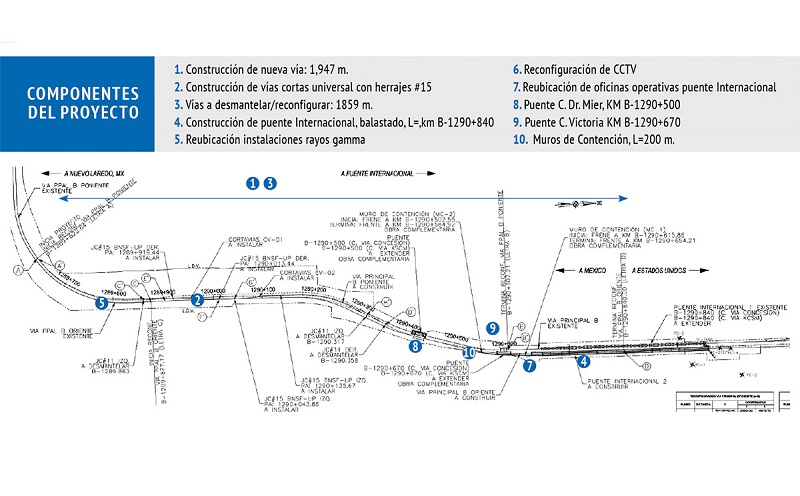
For this reason, they have planned an investment of approximately 120 million dollars for the construction of a second bridge between the two Laredos, whose completion is projected for the third quarter of 2024.
According to information provided by CPKC , the new project will incorporate, among other things, the reconfiguration of 1,859 m of track and the construction of a new 1,947 m track; the relocation of gamma ray installations and CCTV systems , as well as the operational offices of the international bridge.
“With the second bridge we open 24-hour windows, 365 days a year, both to the north and to the south. This will allow us to double the current train capacity, which is between 28 and 32 in both directions”, added the president of the company.
The project also considers the expansion of the Sánchez yard, south of Nuevo Laredo, which will allow them to expand their classification capacity. They are doing the same in the Patio Laredo, on the other side of the border, which will ensure uninterrupted exchange capacity throughout the year.
An additional value is that Laredo becomes the only point with international crews, “which means that the train does not have to stop on the bridge for the crew to get off the locomotive. CPKC takes steps so that the Mexican crews, for example, can go by train to the United States and cross it directly to Mexico”.
Del Cueto indicates that added to the above, they have the advantage of having an inspection point where the CBP ( Custom Border Protection ) and the SAT ( Secretaría de Administración Tributaria ) work in the same office to carry out customs tasks, in addition to permanently and simultaneously monitoring train crossings.
Approximately, the load ratio of a railway is 300 trailers, which becomes relevant if we take into account that at border crossings there are sometimes lines of up to two kilometers waiting to pass. The commitment to offer more options with the railway infrastructure will contribute to solving delays and speeding up the flow of goods throughout the supply chains, a problem that worsened during the pandemic, so creating an agile border area will be an advantage competitive not only for CPKC, but for the logistics of the region, supported by the infrastructure of the Rio Grande area.
“We seek to create a network without borders to connect the three countries in a legal framework that already offers us advantages, such as the T-MEC. The Railroad will be, without a doubt, the backbone of the Free Trade Agreement”, affirmed the interviewee.
ACHIEVABLE GOAL
Little by little, since 1997, when KCS obtained the concession for the use of tracks in Mexico, the railway infrastructure has become more agile and modern. “We have doubled the load since then. Before it was lost, it did not arrive, it was lost or it was delivered to another destination. Today companies can monitor their loads and know where they are. There is a clear commitment to growth to reach the most developed areas of the country.”
Del Cueto commented that the Secretary of Infrastructure, Communications and Transportation (SICT), Jorge Nuño Lara, has shared the federal government's vision of ensuring that rail transport reaches 40% of the country's land freight transport, the same as in the currently around 26%, a very achievable goal.