Advertising
The Gross Domestic Product (GDP) of Sonora is a crucial indicator reflecting the economic activity in the state. Sonora stands as one of Mexico's most important states economically. Over the years, Sonora's GDP has experienced steady growth, driven by various key sectors such as manufacturing, agriculture, and mining.
Mining plays a significant role in the state's economy, with the extraction of minerals such as gold, copper, silver, and molybdenum. The manufacturing sector in Sonora is another fundamental pillar of its economy, encompassing a wide variety of industries ranging from food and beverage production to the manufacturing of electronic and automotive products.

Foreign Direct Investment (FDI) in Sonora is a strategic engine driving the state’s economic transformation. In a global landscape shaped by the reconfiguration of supply chains and the rise of nearshoring, Sonora has skillfully leveraged its geographical and structural advantages to establish itself as a prime destination for international capital.
With nearly 600 kilometers of shared border with the United States, proximity to key states like Arizona and California, a robust logistics infrastructure, and pro-investment public policies, Sonora has attracted significant investments from countries such as Germany, Japan, South Korea, and, of course, the United States.
The state’s development strategy focuses on high-value sectors: mining, clean energy, and advanced manufacturing. These industries not only require significant capital but also a skilled workforce. As a result, the availability of qualified labor, supported by strong technical and professional training programs, has become one of Sonora’s most valuable assets.
Sonora has firmly positioned itself as a hub of economic development by capitalizing on its strategic location, natural resources, and forward-thinking public policies to attract foreign investment, boost growth, and enhance its competitiveness in the global market.

Sonora is a state known for its productive diversity, with key sectors that play a fundamental role in its economic development. Among the most prominent industries are mining, food processing, the chemical industry, as well as the manufacturing of metal products and machinery. The production of transportation equipment, electronic devices, communication systems, and measurement technology also stands out.
These sectors are not only essential to Sonora's economic structure, but they also act as pillars that drive innovation, competitiveness, and sustained growth in the region. As a result, Sonora has positioned itself as a key player in both the national and international economy.
Automotive and Electromobility
Sonora has established itself as a key hub of the automotive industry in Mexico and is making steady progress toward electromobility.








Aerospace
Sonora stands out in Mexico’s aerospace industry due to its infrastructure, border proximity, and contribution to manufacturing and binational trade.








Electrical-Electronic
Sonora is key in Mexico’s electrical-electronic industry, standing out for its manufacturing capabilities, innovation, and international exports.







Medical
Sonora is an emerging hub in the medical industry, with strong investments in technology, research, and medical device manufacturing.








Agroindustrial
Sonora is a benchmark in the agroindustrial industry, with diversified agricultural production and high-quality food exports.







Mining
Sonora stands out in the mining industry, being a major producer of precious metals, especially copper, with advanced infrastructure.




Energy
Sonora is a reference in the energy industry, with significant investments in renewable energy, primarily solar, driving regional development.




Information technology
Sonora is an emerging hub in information technology, with growth in software development, innovation, and digital services.
















In Mexico, there are 151,435 young people enrolled in engineering, manufacturing, and construction programs, of which 28,330 students are from the state of Sonora
The areas with the highest number of men and women enrolled in bachelor's degree programs were:
| Bachelor's Degree Program | Number of Enrolled Students |
|---|---|
| Engineering, Manufacturing, and Construction | 19,304 |
| Administration and Business | 9,462 |
| Social Sciences and Law | 5,772 |
Source: ANUIES, 2023-2024.
| Bachelor's Degree Program | Number of Enrolled Students |
|---|---|
| Administration and Business | 13,794 |
| Health Sciences | 10,432 |
| Social Sciences and Law | 9,954 |
Source: ANUIES, 2023-2024.
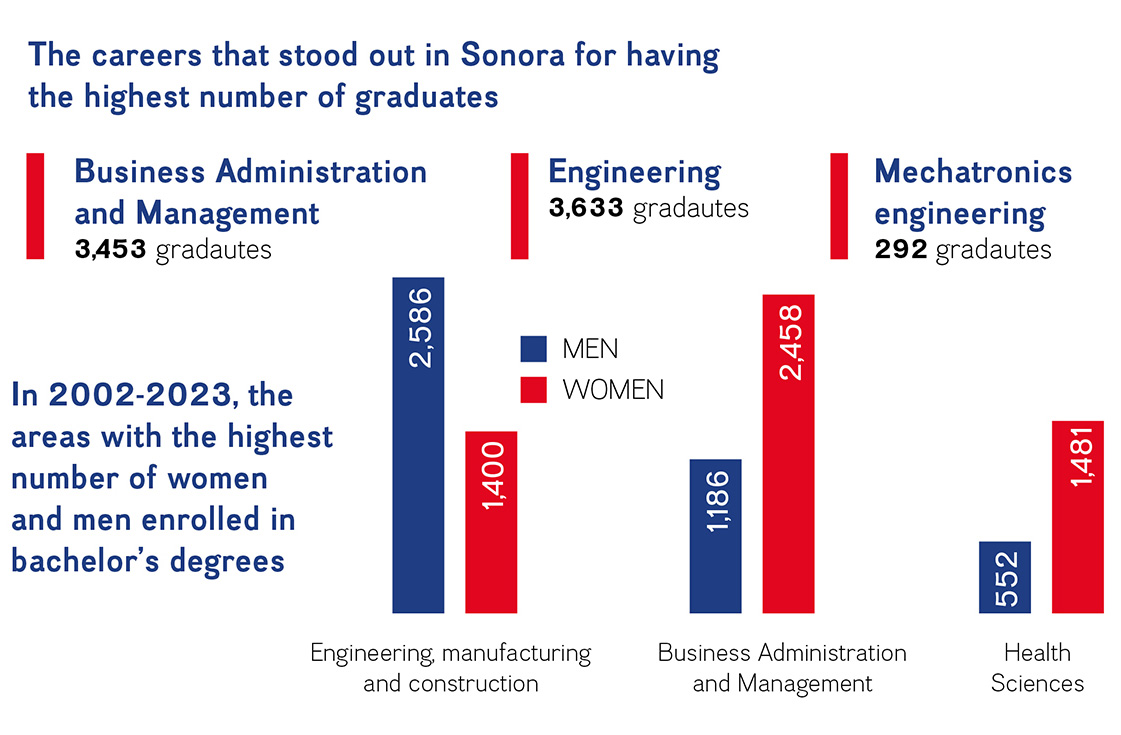 Source: National Association of Universities and Institutions of Higher Education 2022-2023/Data México.
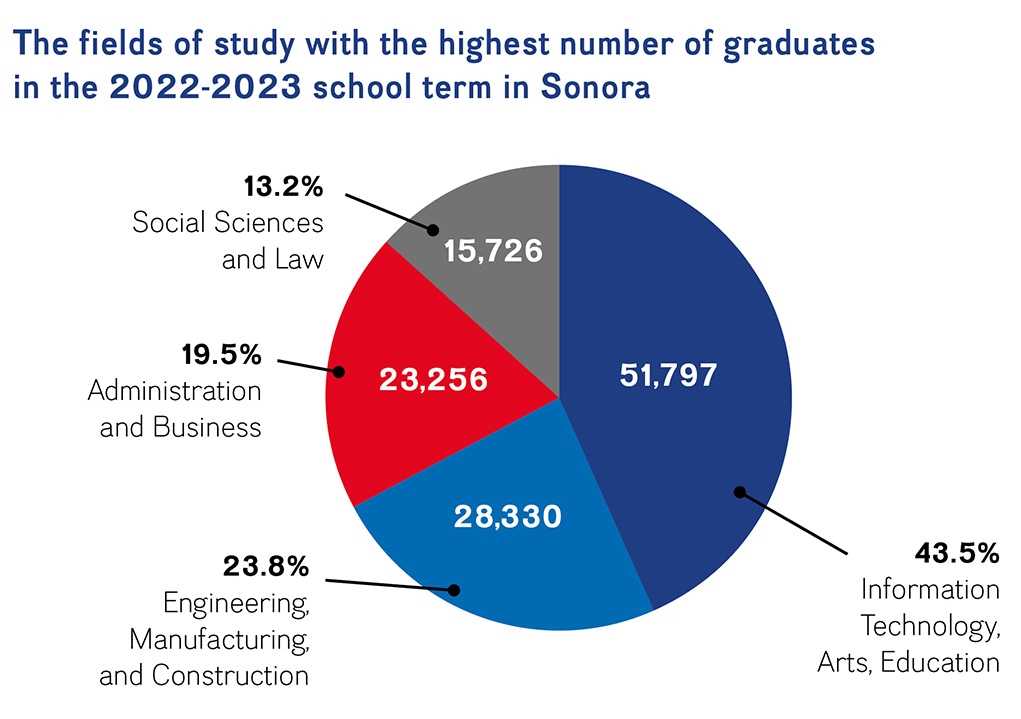 Source: Data Mexico/Inegi