



ESD Control: An Invisible Risk Across All Industries
October 1, 2025
Electrostatic discharge (ESD) is often referred to as the invisible threat. It can’t be seen or heard, and in many cases, operators don’t feel it. Yet its impact can be devastating. From damaging microelectronic components to compromising sterile environments, ESD can silently erode product quality, reduce operational efficiency, and increase costs across industries.
While ESD is most commonly associated with electronics manufacturing, its implications stretch much further. Modern production lines across sectors, from medical to aerospace, depend on precision and reliability. Even the smallest discharge can cause component degradation, software errors, contamination risks, or unexpected downtime.
Electronics and Semiconductors: Safeguarding Tiny Giants
In electronics manufacturing, components are shrinking, while their sensitivity to static discharge is increasing. Microchips and printed circuit boards can fail permanently with discharges as low as 100 volts, far below the human perception threshold.
Controlling ESD in electronics requires a systemic approach:
● Establishing EPA (Electrostatic Protected Areas) with dissipative flooring and grounded workstations.
● Using ESD garments and grounding devices such as wrist straps and heel straps.
● Incorporating ionization systems to neutralize charges in the air and on insulating surfaces.
● Implementing packaging solutions, such as ESD bags and shielding materials, that prevent damage during storage and transportation.
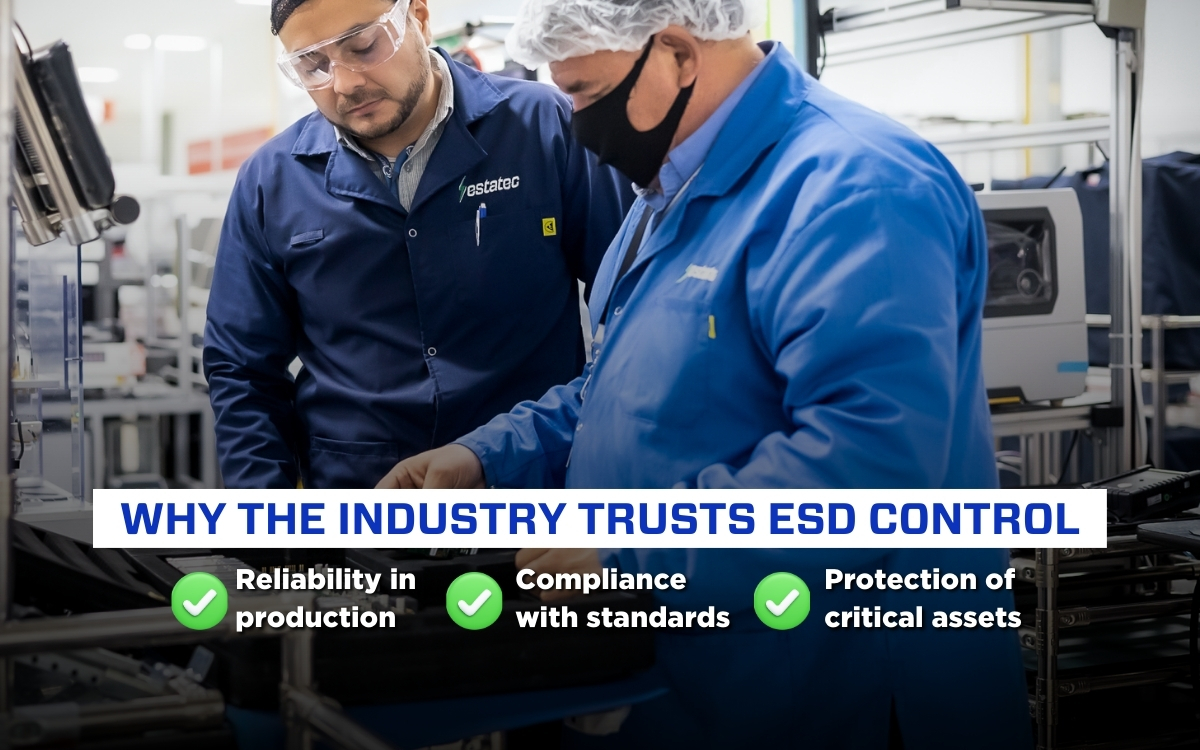
This combination ensures consistent quality, reduces costly rework, and secures compliance with international standards such as ANSI/ESD S20.20.
Automotive: Reliability on Every Circuit
Vehicles today contain dozens of electronic modules, ranging from engine control units to safety sensors. The automotive sector can’t afford unpredictable ESD failures that compromise both performance and safety.
To mitigate risk, automotive operations integrate:
● Personal grounding protocols to prevent operators from introducing charges into assembly lines.
● Dissipative furniture and mats that maintain neutral conditions during component handling.
● Protective garments and footwear that balance static safety with ergonomic comfort for workers on long shifts.
The outcome is improved reliability, lower defect rates, and stronger adherence to strict automotive quality standards.
Medical Devices: Where Precision Meets Patient Safety
The stakes in medical device production are even higher. Diagnostic equipment, surgical instruments, and implantable technologies demand flawless reliability. An invisible static event can compromise the accuracy of a diagnostic machine or reduce the lifespan of an implant.
In these environments, controlling ESD requires a dual focus on both electrostatic safety and hygienic compliance. Cleanroom garments made from specialized fabrics must simultaneously dissipate charges and block particles. Footwear, mats, and ionizers ensure the workspace remains both sterile and electrostatically controlled.
This dual protection not only prevents component damage but also secures regulatory compliance, ensuring products meet international standards before reaching patients.
Pharmaceuticals: Protecting Integrity in Every Batch
Pharmaceutical production is about consistency, sterility, and safety. ESD here is not only about protecting equipment but also about preventing contamination. Static charges can attract particles, disrupt filling processes, or even cause sparks in environments with volatile substances.
Effective ESD management includes:
● Cleanroom garments and footwear designed for GMP-compliant environments.
● Antistatic packaging to transport and store sensitive chemicals or medications.
● Monitoring systems that ensure conditions remain stable and predictable.
By controlling these factors, pharmaceutical operations minimize risks of contamination, product loss, and regulatory non-conformity.
Aerospace: Zero Margin for Error
Aerospace manufacturing pushes technology to its limits. Satellites, avionics, and navigation systems can’t tolerate a single uncontrolled event. Reliability is paramount, and any ESD-related failure could have catastrophic consequences.
Solutions in this sector emphasize robustness: heavy-duty ESD garments, specialized ionization systems for composites, and certified packaging for mission-critical components. By controlling the invisible, aerospace companies ensure that every launch and mission operates without unseen risk.
Beyond Electronics: Expanding ESD Awareness
While industries such as printing, food processing, and ballistics may not be traditionally associated with ESD, they too face hidden challenges. In printing, static disrupts alignment and causes quality defects. In food production, it can attract dust or particles, compromising hygiene. In ballistics, static poses pose direct safety risks.
Recognizing ESD as a cross-industry issue is the first step toward building resilient processes.
Estatec: Turning Expertise Into Industry Protection
For over 25 years, Estatec has specialized in transforming ESD control into a measurable advantage for industries worldwide. From garments, footwear, and personal grounding devices to packaging, ionizers, and furniture, Estatec develops end-to-end solutions tailored to the unique challenges of each sector.
Certified under ISO 9001:2015 and recognized as an ESDA Channel Partner, Estatec combines innovation with rigorous quality assurance. Its portfolio, known for its reliability, adapts to electronics, automotive, medical, pharmaceutical, aerospace, and other industries where invisible risks demand visible solutions.
Estatec protects what can’t be seen, so operations across industries can run safely, reliably, and without interruption.
Get a Quote for your ESD Apparel Today! Contact Us.
ESTATEC
Industria aceitera #2416 Fracc. Zapopan Industrial Norte C.P. 45130
Zapopan, Jalisco, México.
33 3814 5626
www.estatec.com